
Living Museum of Learning
A “Weak in Math” Fourth Grader Builds a 3D Motion World in 27 Seconds
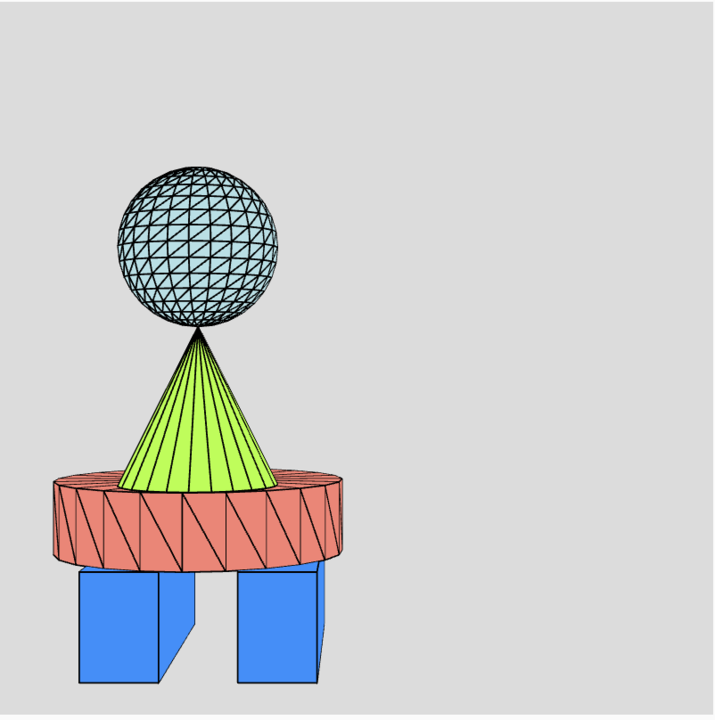
Landon is a fourth-grade student in Chicago. His family has long assumed he is “not strong in math,” especially compared to his older sibling, who is seen as more logical. But in a 27-second P5JS project, he builds a dynamic 3D scene: A black-and-white Earth floats above a rotating cube. A blue sphere descends while spinning. A cylinder rises, revealing its top, side, and bottom as it rotates. A torus travels from left to right, rotating as it passes through the cylinder. The scene becomes a coordinated “3D performance” of motion, shape, and interaction.
What changes the interpretation is not the code itself — but the realization of what it already contains. This is not “weak math performance.” It is unrecognized mathematical thinking expressed visually.
Inside this 27-second animation, multiple mathematical ideas are already active: spatial reasoning: how 3D objects rotate and intersect coordinate transformation: how motion is defined and controlled structural timing: how multiple objects move in coordinated sequence The system behaves like a living geometric stage. Math is not being learned first and applied later — it is already embedded in the act of building motion.
Mathematical ability is often misjudged when it is measured only through written formats.
But in computational environments:
geometry becomes movement equations become behavior understanding becomes visible structure
A child may appear “weak in math” in one system, while already demonstrating strong mathematical reasoning in another.
What Is Possible
☐ Express geometry through real-time motion ☐ Build 3D worlds using simple code tools ☐ Reveal mathematical thinking outside traditional tests
How Does It Happen
☐ P5JS used as a real-time 3D visual canvas ☐ Objects defined by rotation, position, and transformation ☐ Motion choreography encodes geometric relationships
Why Does It Matter
☐ Math ability is not limited to paper-based performance ☐ Children can show reasoning before formal instruction ☐ Visualization reveals hidden cognitive strength