
Living Museum of Learning
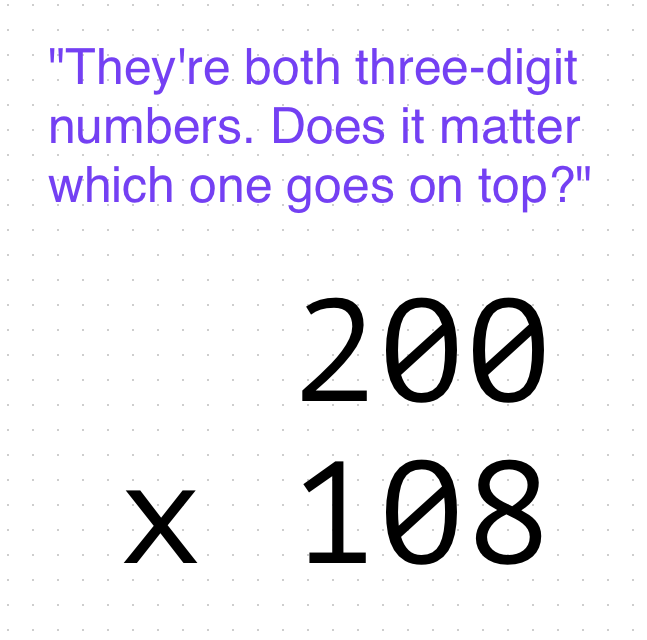
Who Goes on Top?
During a lesson, Andy wrote: 200 × 108 Because there was not enough space below the whiteboard, he continued the multiplication on the right side. When asked about the arrangement, he said: "They're both three-digit numbers. Does it matter which one goes on top?" The room became quiet for a few seconds. Andy was not struggling academically. His parents are experienced engineers. He is bright, curious, and highly capable in programming projects. When building software, he often moves with remarkable energy and creativity. Yet here, an elementary arithmetic structure had never fully taken root.
The issue was not the answer. The multiplication itself could eventually be completed. The question was: Why do we arrange multiplication vertically in a particular way? What do the rows mean? Why do the partial products line up? Why is one number often placed above the other? For Andy, these questions had never really been explored. What looked like a careless mistake turned out to be a missing piece of understanding.
Many learning gaps remain invisible for years. Strong students often compensate with intelligence. They estimate. They guess. They memorize. They move around the missing pieces. Only occasionally does a simple classroom moment reveal: Something important was never fully built. This was not a story about weakness. It was a story about hidden foundations.
Parents often assume:
"This is not important."
Or:
"The school will take care of it."
But mathematical foundations are not simply procedures.
They are structures.
Understanding why an algorithm is organized the way it is helps children:
reason about mistakes organize their work understand place value build later algebraic thinking
The goal is not perfect arithmetic.
The goal is coherent thinking.
* What Was Really Being Learned *
The lesson was not about multiplication.
It was about:
place value mathematical structure organization of thought understanding rather than procedure
Sometimes the most important discoveries occur not when children succeed, but when hidden assumptions finally become visible.
You may laugh when you first see the multiplication.
But what this moment reveals is not a weak student.
It reveals how easily important ideas can remain unseen.
The question is not:
"How could he make this mistake?"
The question is:
"How long had this understanding been missing without anyone noticing?"