
Living Museum of Learning
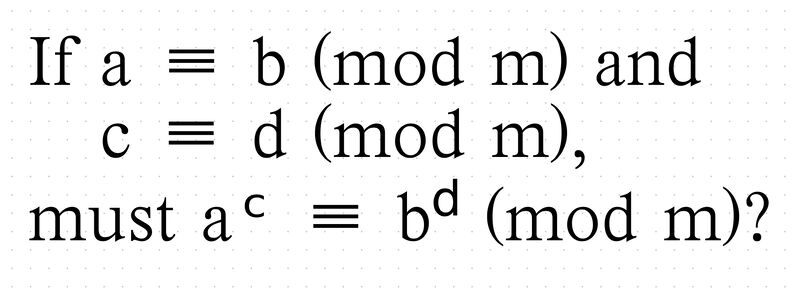
Two Tempting but False Statements in Modular Arithmetic
During a morning exploration of modular arithmetic, I experimented with two statements that initially looked “obviously true.” Both are the kind of claims that feel natural when you transfer intuition from ordinary arithmetic into modular systems. The goal was not only to test them, but to turn them into meaningful reasoning problems for students like Ethan and Albert.
1. First statement Does ac ≡ bc (mod m) imply a ≡ b (mod m)? A quick counterexample breaks it: Take: m = 4 c = 2 a = 5 b = 3 Then: 5·2 = 10 3·2 = 6 10 ≡ 6 (mod 4) So: 5·2 ≡ 3·2 (mod 4) But: 5 ≢ 3 (mod 4) So cancellation fails in general. 2. Second statement If a ≡ b (mod m) and c ≡ d (mod m), must aᶜ ≡ bᵈ (mod m)? This looks even more plausible, but fails as well. Take: m = 4 a = b = 2 c = 5 d = 1 (since 5 ≡ 1 mod 4) Then: 2⁵ = 32 2¹ = 2 32 ≢ 2 (mod 4) So exponentiation does not preserve modular equivalence in this way.
Two different “obvious” algebraic intuitions break in different ways: cancellation fails unless hidden conditions (like gcd(c, m) = 1) are present exponentiation does not behave like multiplication under modular equivalence What emerged is a clearer picture of how modular arithmetic silently breaks familiar algebraic rules. The key shift is from trusting symbolic similarity to actively constructing counterexamples.
Intuition from standard arithmetic does not transfer automatically to modular arithmetic
Cancellation requires hidden structural conditions
Exponentiation behaves fundamentally differently from multiplication
Counterexamples are not edge cases — they are central reasoning tools
Small integers are often enough to expose deep algebraic structure
Mathematical maturity begins when “obvious” statements are tested, not accepted